Three of your four voices say SURE. Most of the time they're guessing.
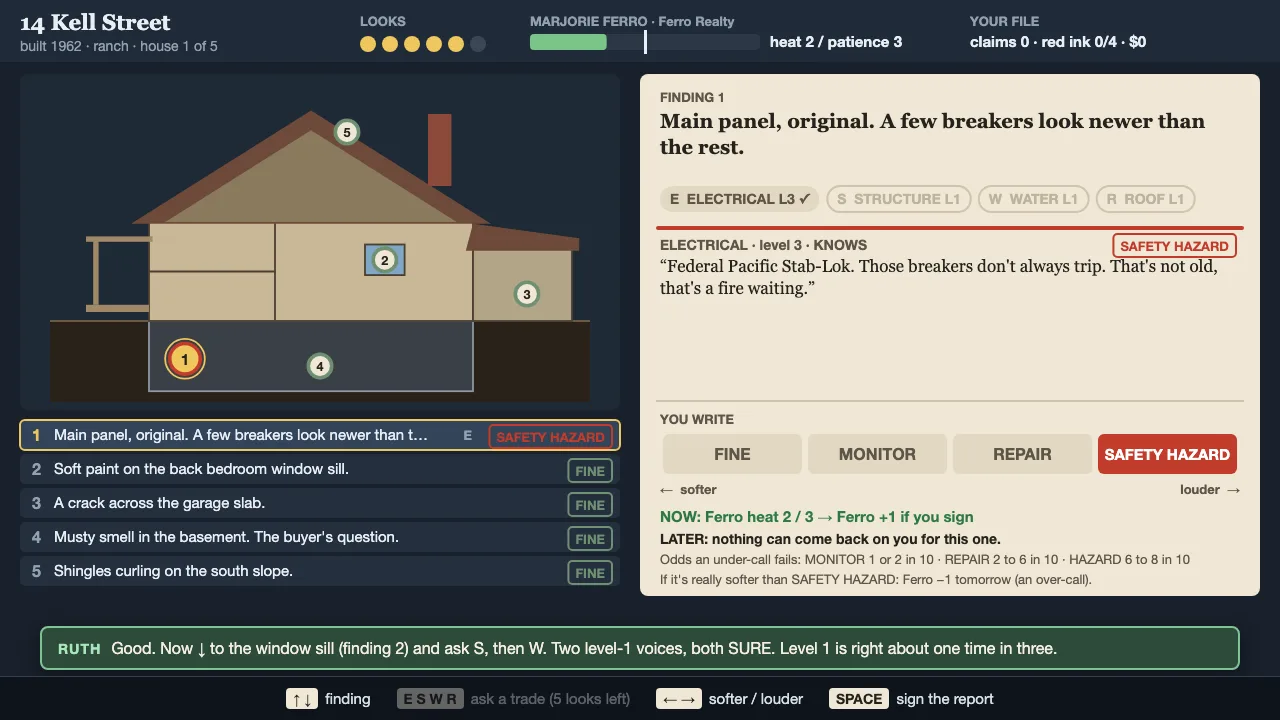
You don't inspect alone. You've got four trades: ELECTRICAL, STRUCTURE, WATER and ROOF. Ask one about a finding and it answers at your level in that trade. Each question costs a look, and you get six per house (four hours on site, forty minutes a look).
Your electrical is level 3. It KNOWS. It never lies, and it's how you learn what knowing sounds like.
The other three start at level 1, and level 1 says SURE. The game measures how often SURE is right. A third of the time.
Levels 1 and 2 measured by the game's own audit over every non-electrical reading (npm run sim). Level 3 is written to equal the truth, and the audit enforces it.
At Kell Street, your STRUCTURE looks at the crack in the garage slab and says “That crack's moving. Slab's settling. Write it.” Your WATER smells the basement and says “That smell is mold. Mold is a hazard. Red ink.”
Both are SURE. Both are wrong. Of the seven non-electrical readings at the first house, five are wrong.
Asking STRUCTURE, WATER or ROOF trains that trade, though. Three looks gets it to level 2 and seven to level 3, starting the next morning, so the week is also you working out which of your own instincts to trust. Ruth, your old boss, gets it down to one line: “never write red on a voice that doesn't KNOW.”
Write it soft and a letter might come two houses later
Signing doesn't end anything. It starts a queue.
Your client is the buyer. The realtor is who sends you the next house. Write a REPAIR or SAFETY HAZARD that's louder than the truth and the buyer's engineer finds out. The realtor hears about it the next morning, and you lose standing with them. Lose enough and they stop calling. Then you're taking houses off the cold listing board at half the fee.
Write something softer than it really is and you roll against that finding's own odds. The screen prints a rough band for each severity: six to eight in ten for a real hazard. If it fails, a claim letter arrives two houses later, at $200 for every step you under-called. Under-calls from houses 4 and 5 land in Friday's mail instead.
Your insurance renewal, the morning of house 4, reads every claim in the file.
Writing it loud and correct costs too. Kell Street written exactly as it is comes to 4 heat against Ferro's patience of 3, so the honest report costs you standing with her on day one. The stuff that doesn't fail just stays quiet. Quiet isn't the same as right, and the game never tells you which quiet ones were luck.
There's a best hand. It isn't the honest one.
You might expect a lecture: write everything honestly, get a gold star. The game's test hands say otherwise. They're bots that play the whole week through the real code and see only what you see.
| hand | what it does | avg score | 3 stars |
|---|---|---|---|
| The parrot | asks around, writes what its greenest voice says | 542 | 0% |
| The diplomat | never writes SAFETY HAZARD | 914 | 1% |
| The thorough one | asks until the looks run out, writes the loudest reading | 1,028 | 0% |
| Honest by default | writes its best guess, ignores the realtor | 1,216 | 1% |
| Calibrated | trusts the best voice; when the realtor's patience runs out, softens the REPAIRs it trusts least | 2,192 | 67% |
Mean over 200 weeks (seeds 1 to 200), npm run table. Score is
Friday's cash plus Monday's bookings.
The best hand under-calls on purpose sometimes, and it's careful about which ones. It still pays about four claims a week (3.98 on average). The game doesn't approve of that or condemn it. It sends the bill.
Five houses, five things the buyer is scared of
Three realtors, twenty-five findings. Tom Bassey sets the tone: “Be straight with them and kind to me.”
- 14 Kell Street, 1962 ranch: “The buyer keeps asking about a smell in the basement.” You've met it.
- 7 Alder Court, 1924 bungalow: “First house. Everyone has told them about old wiring.” Knob and tube, buried under blown-in insulation, and a scorch mark on a rafter.
- 301 Pell Street, 1978 split-level: “The buyer's kids will live on that back deck.” An untrained STRUCTURE says “Deck's solid. I jumped on it.”
- 22 Orchard Row, 1951 cape: “The buyer is a retired carpenter and will check your work.”
- 9 Halyard Lane, 2004: “It was flipped in six weeks. The buyer has heard about flips.” There's fresh paint on exactly one kitchen ceiling patch.
Friday the last claims arrive, and Monday's calendar shows which realtors still want you. Friday's cash plus Monday's bookings is your grade: Uninsurable, Still working, Busy and covered, or The one they recommend.
If you've ever stood in a crawlspace
The findings are the real ones. Federal Pacific Stab-Lok breakers, the kind that don't always trip. Aluminum branch wiring (“Every twist joint is a heater”). A deck ledger that's nailed instead of bolted, which is how decks come off houses. No kickout flashing, so every storm runs down into the wall. A bath fan that dumps steam into the attic instead of outside.
What's simplified: every finding has one fixed failure chance, and the screen prints only a rough band for each severity. The realtors are three people with a patience number. A claim is a flat $200 a step.
One more thing, plainly. The game prices the pressure to write soft. It isn't telling you to.
Honest gripes
- It's keyboard only: arrows, space, number keys and four letters. It won't work on a phone (the house up top will).
- It's one week, five houses. You can replay with different claim luck, but the houses stay the same.
- No music yet, just a few tones.
- There's no mid-week save, so a week is one sitting.
- It was finished on October 6, 2026. Nobody outside the automated test runs has played it. I'd rather you know that.
Questions
- Is it free?
- Yes. No account, no ads, nothing to buy.
- How long is a week?
- Five houses. My guess is about twenty minutes, but nobody's timed a real person yet.
- Do I need to know anything about houses?
- No. The trades tell you what they think. Knowing which one to believe is the game.
- Can I play on my phone?
- The house up top, yes. The full week needs a keyboard, so send yourself the link.
- Does my report from this page carry over?
- No. The game starts you at Kell Street (with Ruth on the phone the first time). Same house, so you'll know the panel.
- Can I replay it?
- Yes. SPACE on Friday starts another week: same houses, different claim luck.
Sign the week
Five houses. Four trades that are sure of themselves. Both prices are on the dial before you sign, and which quiet ones were luck, you never find out.
Start the week →P.S. On the week the game starts you on, the Stab-Lok panel at Kell Street fails if you write it anything less than SAFETY HAZARD. The letter says “A Stab-Lok breaker failed to trip and scorched the panel,” and it arrives at house 3. Your electrical told you. It always does.